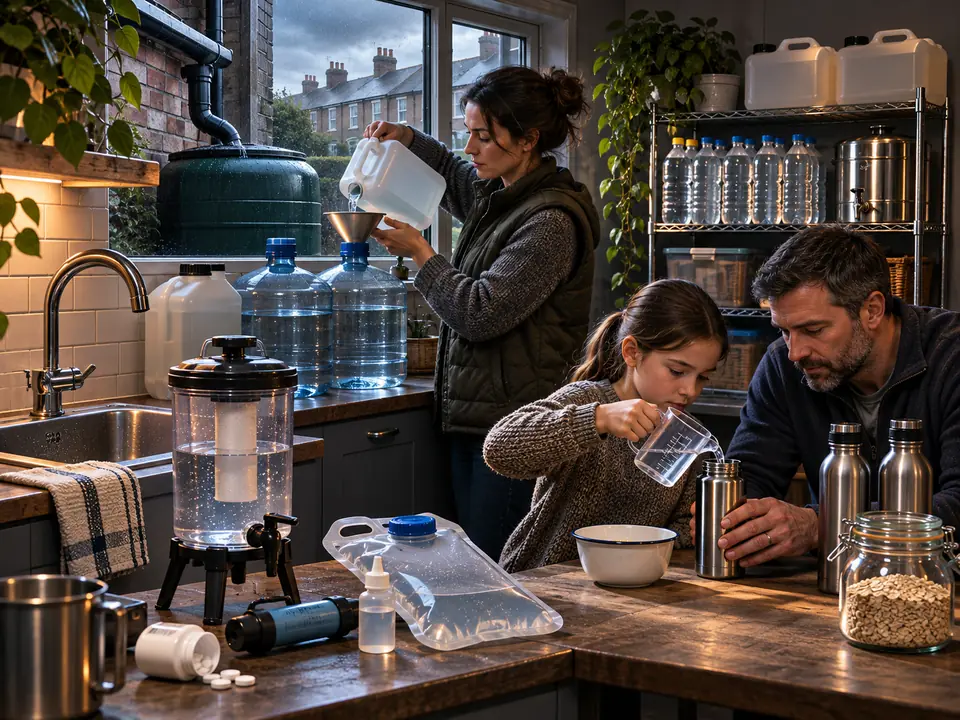
Emergency water storage
In a long or wide power cut, water pressure can drop or the supply can stop. This guide explains how much to store, how to store it in a small home, and what to do if you run low.
In a short power cut, your taps carry on as normal. In a long or wide outage, water pressure can fall or the supply can stop, which is why storing some water is one of the most useful things you can do. You also need some water for washing hands and cooking, so it helps to know the difference between the official minimum and a more comfortable plan.
How much water
| People in your household | 3 days | 7 days |
|---|---|---|
| 1 person | 9 litres | 21 litres |
| 2 people | 18 litres | 42 litres |
| 3 people | 27 litres | 63 litres |
| 4 people | 36 litres | 84 litres |
These are simple multiplications of our own plan, not official figures. Start with three days. A week is a stretch goal that most households do not need.
While your taps still run
That is the moment to fill containers, if you have warning of a storm or the power has just gone off.
Containers and where to keep them
- Use clean containers. The Chief Medical Officers say never to use one that has held fuel or paint.
- Bottled water is the easiest option. Keep it in a cool, dark place.
- You can also fill clean, food-grade bottles or water carriers with tap water. We could not find an official UK figure for how long this stays fresh, so as our own suggestion, swap it every six months and smell it before use.
- Do not fill containers so full that they burst if they freeze, and keep water away from frost.
- In a flat
- Use small, flat or stackable containers under a bed, behind a sofa and inside a wardrobe, so no single spot takes the load. Heavy water is hard to carry up stairs, so a few smaller bottles are easier than one large one.
- In a house
- You can store more, but keep it inside, not in an unheated garage or shed where it may freeze.
- On a small budget
- Wash and refill bottles you already have, such as clean juice or water bottles with screw caps. You do not need to buy specialist containers.
- With limited storage
- Plan for three days of drinking water first, around 6 litres per person at the official 2-litre minimum.

If your water runs low
Keep drinking water for drinking. The Chief Medical Officers advise keeping most of your water for drinking, handwashing and preparing food, and not using it for showers or baths. If you must use another source:
Toilets and hands
This is the advice for a wide, long outage. In a short cut that only affects your street, your toilet will usually still flush.
Keep this guidance offline
The 72-Hour Plan is a free 21-page digital PDF that gets a household ready for three days without power. The Black Sky Handbook is a 188-page digital PDF for £9.99, with planning for seven and fourteen days. Both are PDFs you can save to a phone or print.
Sources
- Water and sanitation: scripts for broadcast media, UK Chief Medical Officers, 16 December 2025
- Prepare for a power cut, British Red Cross
- Households encouraged to take small, simple steps to stay prepared in an emergency, Cabinet Office, GOV.UK
The Chief Medical Officers describe their advice as independent and not government policy. We did not find official UK guidance on how long stored tap water keeps, or on how much water to keep for cooking and washing, so those parts are our suggestions.