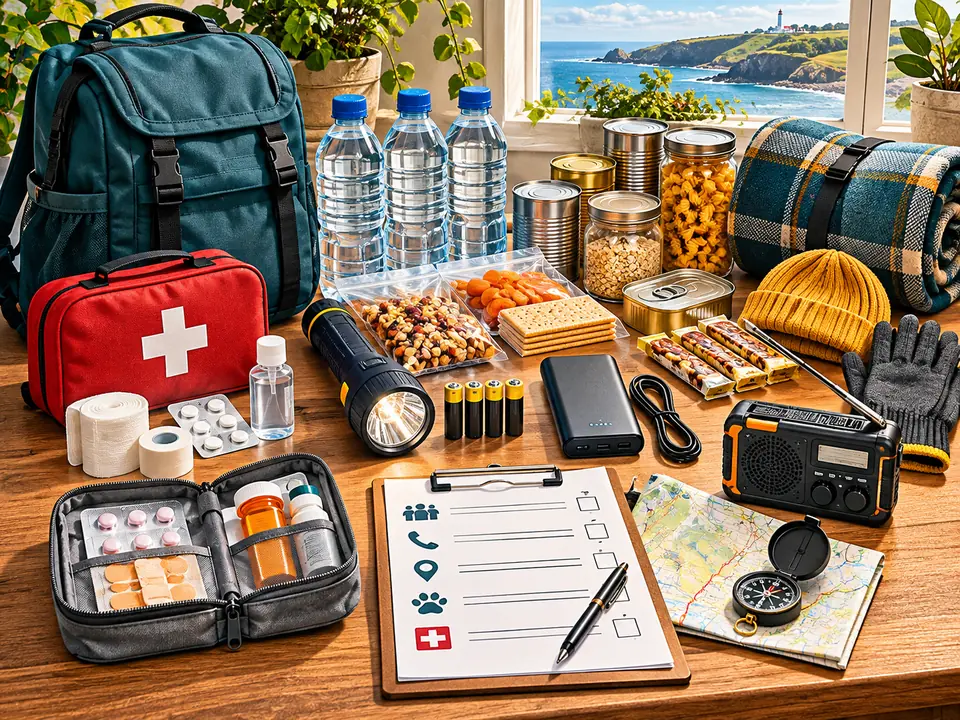
A household emergency kit checklist
A three-day kit for a long power cut does not need to be expensive or take up a lot of room. This checklist puts the items in the order to collect them, and says which ones are official advice and which are our suggestions.
The aim of a kit is simple: to keep your household lit, watered, fed, warm and informed for about three days if the power stays off. Most of it is probably already in your home. Start with the first list and stop whenever it feels like enough.
What official advice says to include
The Government’s Be Ready campaign asks for a small supply of non-perishable food and bottled water, and to be ready for three days of disruption.
First: free or already at home
Second: low-cost items worth buying
Extra items for different households
- Babies and young children
- Formula, bottles and a way to make feeds safely, nappies and wipes, a spare outfit and a comfort toy. The Chief Medical Officers say a child under 2 who is not breastfed needs at least 1 litre of fluid a day, including formula. See the NHS pages on making up infant formula.
- Older or disabled people
- Spare glasses and hearing-aid batteries, a list of medicines, and any equipment charged and ready. Join the Priority Services Register if you might need extra help.
- Pets
- Food and water for three days, a lead or carrier, and the vet’s number. The British Red Cross includes supplies for pets in its kit list.
- People with medical equipment
- Talk to your doctor or healthcare provider about what to do in a power cut. Power NI notes that back-up options include a generator, an uninterruptible power supply or solar battery storage, and that you can ask about NIE Networks’ Medical Customer Care service.
Where to keep it
- In a flat
- Use several small places rather than one large box: water under the bed, food in a kitchen cupboard, and torch and radio by the bed.
- In a house
- Keep the kit in the main part of the house, not a cold garage or loft, so water does not freeze and food stays dry.
- On a small budget
- The first list costs almost nothing. Add one item from the second list each time you shop.
- With limited space
- Choose flat water containers and food you already eat. Keep a printed checklist so you can see what is missing at a glance.
Check it twice a year
Keep this guidance offline
The 72-Hour Plan is a free 21-page digital PDF that gets a household ready for three days without power. The Black Sky Handbook is a 188-page digital PDF for £9.99, with planning for seven and fourteen days. Both are PDFs you can save to a phone or print.
Sources
- Prepare for a power cut, British Red Cross
- Households encouraged to take small, simple steps to stay prepared in an emergency, Cabinet Office, GOV.UK
- Water and sanitation scripts, UK Chief Medical Officers
- Power cut tips, Power NI
- Making up infant formula, NHS